

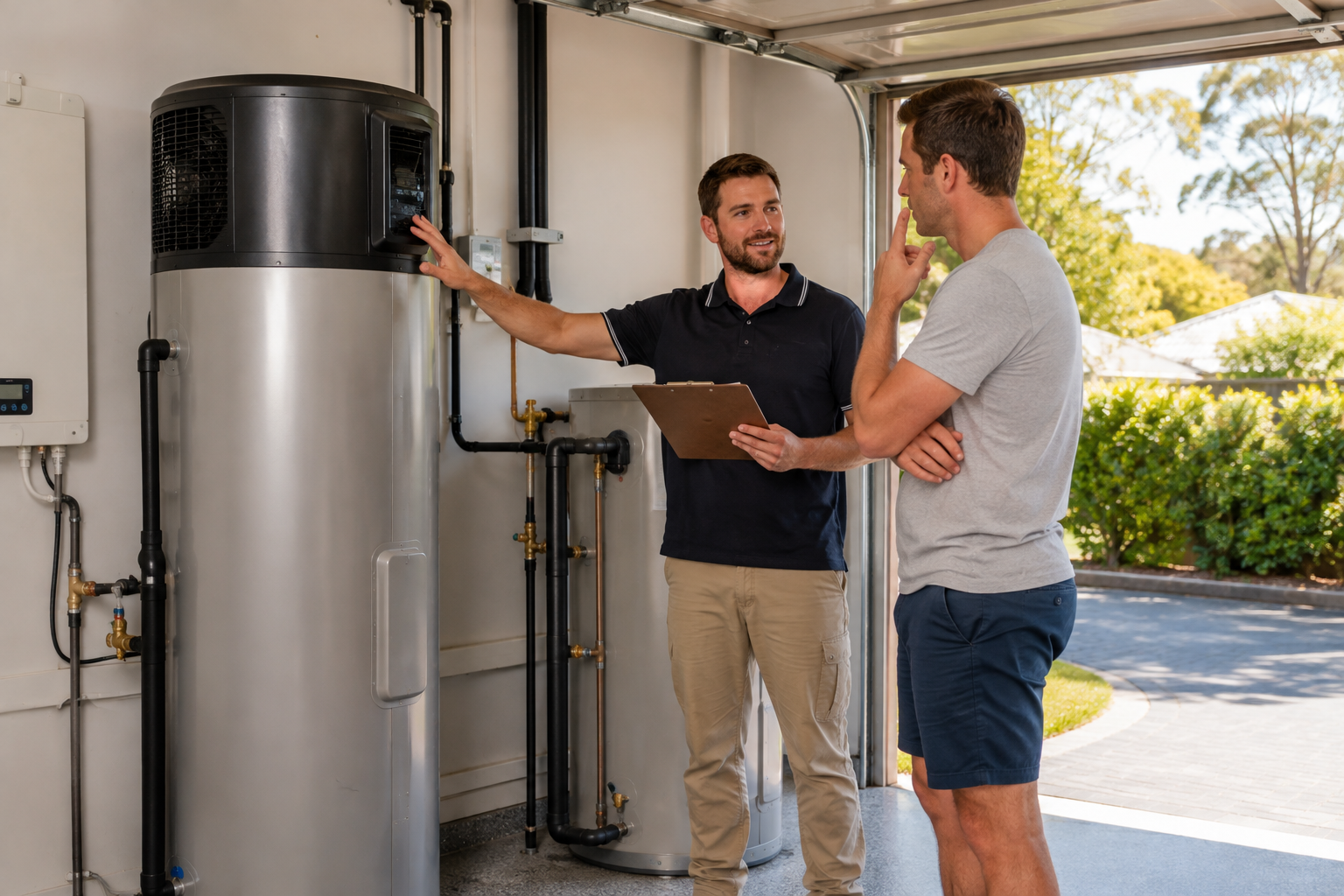
Ask a few licensed plumbers what type of water heaters they recommend, and the same answers keep coming up. Heat pump water heaters lead the list, followed by solar hot water systems, because they use much less electricity, cost the least to run over the life of the unit, and qualify for rebates that bring the purchase price down.
Gas hot water systems and electric hot water systems still get installed, but usually because of an existing gas connection or a tight upfront budget rather than because they are the better long-term choice. In Perth, that tilt towards heat pump technology has happened quickly.
The Clean Energy Regulator reported a 55% year-on-year increase in air-source heat pump installations in WA, and energy-efficient electric systems are increasingly favoured by local councils.
Across all the different types of hot water system, the recommendation comes down to the same three things: energy efficiency, the fuel type you already have connected, and what the unit will cost you to run once it is in.
Why Plumbers Recommend Heat Pump Water Heaters
Heat pumps have gone from a niche product to the default recommendation in about a decade.
1. They Use Far Less Electricity Than a Standard Electric Tank
A heat pump does not generate heat the way an element does. It uses a refrigerant and a heat exchanger to extract heat from the ambient air and move it into the water tank, warming the cold water inside it, and the electricity only runs the fan and compressor. Think of it as a fridge working in reverse, pulling warmth out of the air instead of pushing it out.
That difference in approach is where the savings come from. Heat pump water heaters are two to four times more energy efficient than electric models, using up to 70% less energy than a standard electric resistance tank to heat water for the same household
Conventional electric water heaters turn every unit of electricity straight into heat, so they can never do better than one for one. The environmental benefits follow the same maths. Less electricity drawn from the grid means lower emissions from what is one of the biggest energy users in the house.
If you want the mechanism explained properly, our guide on how heat pumps work walks through it step by step.
2. They Pair Extremely Well With Solar Panels
Heat pumps can significantly lower ongoing energy costs when paired with solar PV. Set the unit to run on a timer through the middle of the day, and it uses the electricity your panels are already generating, rather than exporting it for a modest feed-in tariff.
Homes with existing solar systems are the easiest case of all. The panels generate electricity across exactly the hours a heat pump does its work, so the two run on the same daylight.
For a home with a working solar PV system, that combination is about as close to free hot water as you will get without a solar thermal system on the roof.
3. Perth’s Climate Suits Heat Pump Technology
Heat pumps extract heat from the surrounding air, so they run most efficiently in mild to warm conditions. Efficiency drops off in genuinely cold climates, which is a real consideration in the eastern states and much less of one here.
Perth’s mild winters and long warm season mean a well-sized unit spends most of the year operating in its efficient range.
Add the ongoing shift away from natural gas in WA housing, and the case for an electric heat pump gets stronger every year.
4. Rebates Bring the Upfront Cost Down
The honest trade-off with heat pumps is the purchase price. They cost more upfront than a basic electric storage tank, and that puts some households off before they compare running costs.
Eligibility for STCs, or small-scale technology certificates, applies to approved heat pump and solar hot water installations and is usually applied as a point of sale discount by the installer. The model has to be on the approved list, and the install has to be done by a qualified installer, so it is worth confirming both before you commit.
Our guide to claiming solar hot water rebates in Western Australia covers how that works, and finance options are available if the upfront cost is the sticking point.
Which Water Heater Brands Do Plumbers Trust?
Plenty of water heater brands get thrown around online, including overseas names like Bradford White that are barely present in the Australian market.
The practical test is simpler: can your installer get parts, and will the warranty actually be honoured locally?
For heat pumps, Solar Repairs installs Eurosun.
The HPR-200L and HPR-270L models cover the great majority of Perth households, deliver around 350% efficiency, and come backed by a 6-year warranty. Eurosun has been a consistent performer for us across a lot of installations, which is why it is the heat pump we put our name to rather than carrying a shelf of many models that all need different spares.
On the solar hot water side, we install and service Eurosun, Solahart, Edwards, Beasley, Rheem and Conergy.
Eurosun’s evacuated tube systems with stainless steel tanks and long warranty terms tend to be the standout on efficiency, while Solahart and Rheem have decades of reliability and parts availability behind them.
Our comparison of Eurosun, Solahart and Rheem breaks down where each one is strongest.
Whichever brand you land on, the model needs to be correctly sized and installed by licensed plumbers. A premium unit installed badly will still disappoint you.
 What Plumbers Check Before Recommending a Heat Pump
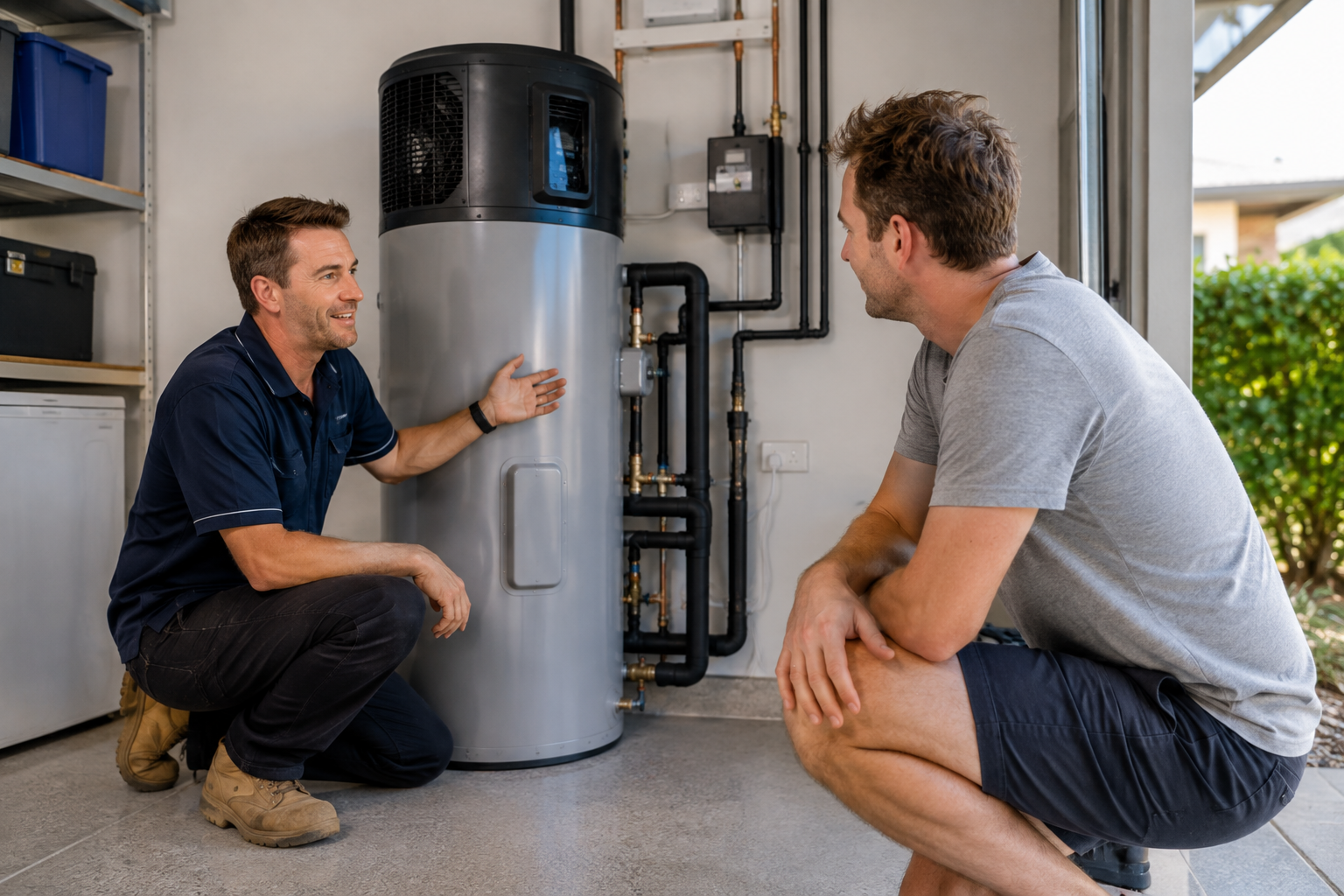
Recommending the right type of system is only half the job.
The other half is matching the model to the home, and this is where most poor installations go wrong.
Household Size and How Much Hot Water You Use
The rule of thumb is roughly 50 litres of hot water per person per day. A couple is usually well served by a 200L unit, while a family of four with multiple bathrooms generally needs 250L to 300L or more.
Storage capacities for residential water heaters commonly sit between about 115L and 300L. The mistake we see most often is replacing like for like with the same size tank when the household has grown or shrunk since the last unit went in.
Our guide on what size heat pump hot water system you need has the sizing detail.
Where the Unit Will Go
Heat pump systems need airflow to work properly, so placement matters. They want a reasonably ventilated outdoor position, and because the fan and compressor make some noise, away from bedroom windows and close boundaries is sensible.
Most heat pump installations take around two to three hours. Placement shapes the recommendation as much as efficiency does, which is also true of the alternatives: gas water heaters usually require outdoor installation for venting, and solar water heaters need clear roof space at the right pitch and aspect.
If space is tight, our post on whether a heat pump can be installed indoors is worth a read.
Warranty Terms, Tank Build and Parts Availability
These are the trade criteria homeowners rarely think to ask about, and they matter more than the brochure efficiency figure.
Check whether the tank and the compressor are covered separately and for how long. Check whether the tank is stainless steel or mild steel with a sacrificial anode rod, because anode rods in mild steel tanks should be replaced roughly every five years as part of normal maintenance. Most importantly, check that spares can actually be sourced locally.
A cheap unit with no local parts availability becomes an expensive unit the first time it fails. It is also the single biggest factor in how long a heat pump hot water system lasts.
When a Plumber Would Still Recommend Another Type
A heat pump is not automatically the answer for every home, and it would be a poor recommendation to pretend otherwise.
Solar Hot Water Systems
Best for homes with clear north-facing roof space and a preference for the lowest possible running costs. Thermal panels or evacuated tubes absorb heat from the sun directly, with a gas or electric booster covering cloudy stretches.
Install cost is typically the highest of the group, but in a climate like Perth’s the payback is genuinely good.
Our full guide to solar hot water systems covers the options, and if you are weighing the two efficient choices against each other, heat pump versus solar water heater compares them side by side.
Gas Continuous Flow
A continuous flow system heats water on demand rather than storing it, so you get unlimited hot water and no standby heat loss, and the compact wall-mounted units save interior space. Best for homes already on natural gas with unpredictable demand.
Keep in mind that running costs climb during peak simultaneous usage, and tankless water heaters need descaling every one to two years.
Gas Storage Units
Simple, proven, and roughly half the running cost of electric storage. Best for larger households with big simultaneous hot water demand where mains gas is already connected.
Electric Storage Tanks
Still the most common type in older Perth homes and the cheapest to buy. Best only where the budget is genuinely tight, and neither gas nor a suitable heat pump position is available.
The general point holds across all of them: the cheapest hot water system to buy is rarely the cheapest system to own over ten years.
Need a Hot Water Heater System? Contact Solar Repairs Today!
The right hot water system saves you money every single day it runs. For most Perth homes, that means a heat pump, and for most heat pump installs, it means getting the sizing, placement, and brand right from the start.
Solar Repairs installs and services heat pump and solar hot water systems across Perth, with licensed plumbers who know the local conditions and the products they put their name to.
Get in touch with the Solar Repairs team for a free quote and find out which system suits your home.
